Author Archives: Noelmcoughlan

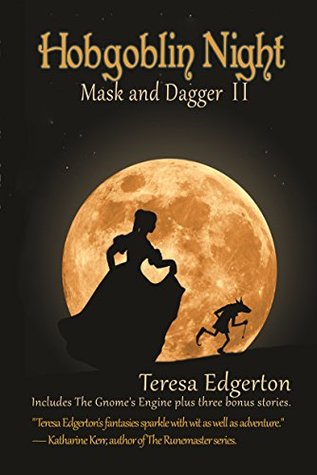
Hobgoblin Night By Teresa Edgerton

Hobgoblin Night


The sequel to Goblin Moon, it was originally published as The Gnome’s Engine. To be frank, I don’t understand the change of name. Personally, I felt the original title is more relevant to the main thrust of the plot.

The story continues where the previous book left off. The sorcerer Thomas Kelly and the Duchess separately hunt Sera, Elsie and Jed. Meanwhile the parchment originally stolen  from the Duchess proves to be the key to unlocking the secrets of the drowned continent of Panterra. Meanwhile, Shelbrooke is busy hunting white slavers.

The world expands a good deal in this second volume. The writing is full of engaging detail and subtle wit.The main plot points are resolved but there are some new questions raised and avenues opened which I suppose adds to the verisimilitude and probably were originally intended for a sequel. Some of the minor characters from the first novel feel kind of underused, perhaps for similar reasons, but overall, the novel was very satisfying.

The novel includes three short stories which either relate to the world of the novel or share the same sensibilities. I particularly enjoyed Titania or The Celestial Bed which was a very clever story setting some of Shakespeare’s characters in the eighteenth century.

June Update

KONICA MINOLTA DIGITAL CAMERA

I haven’t published one of these updates in a couple of months but I’ve been very busy behind the scenes. First of all, I finished the short story I had been working on. After  the rolling pin of Beta Reading and editing had flattened all the bumps, it ended up rolling out to 7k.

I paused work on the novel Diary largely because I found the solution to the problem that dogged the project I had been working on in February, nicknamed Spaghetti. If you remember the February Update, I had parked this project, which involves people being trapped in a massive multiplayer. At the time, while I really enjoyed writing it, I could see it had a lot of issues around how much game mechanics and language to include. I didn’t want to knock a few corners off a square and call it a wheel.

So imagine my delight when I discovered the genre LitRPG. This genre, which began in Korea and Russia and is slowly gaining momentum in the west. Popular series include The Land by Aleron Kong, The Way of the Shaman by Vasily Mahanenko and The Phantom Server by Andrei Livadny.

However, one key factor missing from my story was leveling. The focus was on very advanced players at the top of their game. I needed to go back and build up to the book. So I decided to create a trilogy with Spaghetti as the third volume. To keep things simple, I made it Spaghetti 3 and the first two volumes became Spaghetti 1 and Spaghetti 2.

I started out pantsing Spaghetti 1. Simply put, I built up the story letting myself be led by the words I wrote. This process was helped by a killer beginning that just came to me out of the blue. Everything was going along smoothly until I was about 28k words in. Then I discovered a vast chasm between me and where I wanted to go. I took a deep breath and revised what I had done, but the solution wasn’t forthcoming. I got about sixteen chapters in when I decided enough was enough. I must either map my terra incognita or  I put it aside. I have a dozen projects clamoring to be written. I gave myself two days.

I started to map out the story on Scapple from the point I had reached to the as yet unknown end. Basically, at each stage I asked what would be the most interesting thing that could happen next. I connected these points with arrows and I deleted lines that went nowhere. And very quickly, everything clicked into place. I even had the inciting incident and setting for the next book.

What I didn’t do was break this tapestry of plot threads into chapters. The exercise wasn’t about prescribing to the finest detail what would happen so that writing the book became a form of transcription. It wasn’t about bashing it to fit some preconceived template. No, I left the story space to grow, to surprise me. But I now have a clear idea where I need to finish and a general direction on how to get there. I’m confident I can get the first draft finished in the next couple of weeks.

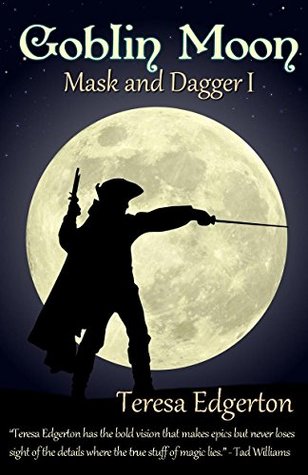
Goblin Moon By Teresa Edgerton

Goblin Moon


This is a fantasy novel set in a world of Men, dwarves, gnomes and fairies, but instead of the usual medieval period setting, the milieu is more akin to the eighteenth century. The period detail is fantastic and the writing is sumptuous. The characters are well drawn. There’s an alchemist-turned-bookseller struggling dabbling in the dark arts. There’s his niece who must defend her cousin from her from the eccentric medical plots of her overbearing mother.  And then, there’s a dashing Scarlet Pimpernel type who fights occult secret societies and the like. It takes a while for the pieces of the story to coalesce into the plot but the journey makes the wait worth it.

The world building is excellent. The eighteenth century elements (and some of the place names) can blind you that at times, but there was obviously a lot more work and thought put into the setting than a simple transposition of historical and literary detail.

My one quibble would be the recipe of a homunculus only in so far as it pushes the age range for which the book is suitable upward. It didn’t bother me particularly, but I could see it bothering others.

It’s the first part of a duology so there are still matters to be resolved in the sequel, but the conclusion at the end didn’t make me feel short changed.


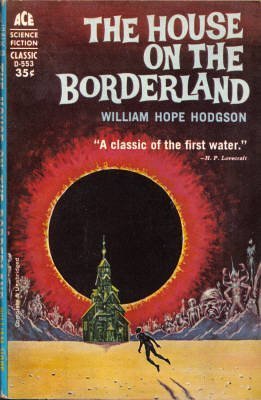
The House On The Borderland By William Hope Hodgson


House On The Borderland

Two visitors to the West of Ireland, Tonnison and Berreggnog, stumble across a ruined house. They discover a damaged book in the midst of the debris. It is the diary of the reclusive former occupant of the house. In it, he recounts a series of bizarre phenomena he encounters while living there.

The influence of this book on writers like Lovecraft is unmistakable. The siege of the house of pig creatures is well done. There is an astounding  passage describing the speed up of time and the author’s experience of the passing of millions of years. It reminded me a lot of 2001: A Space Odyssey. However, other parts are less climatic. I felt frustrated rather than intrigued by the missing pages. The disjointedness and randomness of the events sometimes made me like I was passing through a fun house rather than experiencing an unknowable but cohesive mystery.

The house is strangely divorced from the time and place in which it’s supposed to be set. The odd anachronism doesn’t help. But maybe it’s part of the book’s dream-like charm. It reinforces the isolation (or madness) of the diary’s author and his much put-upon sister.

Tonnison at the end of the book is certain at the end of the novel that the journal is an honest recounting of real events. I wasn’t so sure. There seems to be hints to the contrary. It’s really up to the reader to make her mind up.

The Chessmen of Mars By Edgar Rice Burroughs

Chessmen_of_Mars-1922


Again, John Carter himself is mercifully in the background. Again, the book concentrates on a couple. Tara is daughter of John Carter and Dejah Thoris. I’m intrigued as to where her name comes from. Given that her brother is called Carthoris, shouldn’t she be called Dejohn? Gahan, the jed (chief) of Gathol, loves her though she is engaged to another. (Sound familiar?) When she is lost while flying in a storm, Gahan sets out to rescue her.

This time, we go to two places nobody ever leaves: the land of the walking heads, the Kaldanes, and Manator, a city inhabited by primitive Red Martians. A Martian chess game called Jetan plays a pivotal role in the story, but frankly you don’t need to worry about the longish explanation of the rules in the early part of the book.

Tara does stuff though her role shrinks toward the end to someone to be rescued.  The Kaldane Ghek is my favorite character and there are plenty of twists and turns. I really enjoyed this book and for me it’s the best of the Barsoom novels I’ve read.

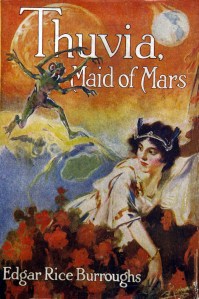
Thuvia, Maid of Mars By Edgar Rice Burroughs

Thuvia_Maid_of_Mars-1920


After the pummeling my nerves received from John Carter’s ego in Warlord of Mars, I approached this book with trepidation. Fortunately, I enjoyed it a lot more than the previous installment. Firstly, the focus isn’t on John Carter, but on the eponymous Thuvia of Ptarth and John Carter’s son, Carthoris. They come across as more rounded, likeable individuals. The villainous Drusar, learning from the mistakes of others, try something more subtle than kidnapping Dejah Thoris  and inviting John Carter to slaughter them. Thuvia, destined to be married to one of her father’s allies, is kidnapped and, in trying to help find her, Carthoris becomes the number one suspect for her disappearance.

Of course, yet again, there’s another region that nobody ever leaves: the ghostly city of Lothar. The inhabitants are an archetype I’ve come across in later novels, and their intriguing nature is never fully resolved.

While there’s a big war brewing, the focus is firmly focused on Thuvia and Carthoris. As soon as their story comes to a close, the novel comes to an abrupt stop. Even if you found A Princess of Mars a bit off-putting,  you might still enjoy this novel.

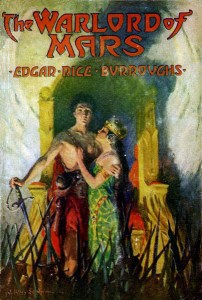
Warlord of Mars By Edgar Rice Burroughs

Warlord_of_Mars-1919


Okay. This one is a bit spoilery. So be warned.

The villains, Matai  Shang and Thurid, in this book have to be the stupidest so far. Have they learned nothing from the destruction their peoples suffered in the last book? Just give Dejah Thoris back to John Carter and he’d stop his hunt for you from pole to pole and go back to Helium and leave you alone. But no, that would be too easy.

Dejah Thoris again suffers from literary laryngitis for pretty much the entire story.

At this stage, the pattern is pretty set. John Carter arrives in some land nobody sensible ever goes to, makes friends with a local and sweeps away any evil tyrant who might be troubling his new acquaintance. At this stage John Carter has an ego the size of Green Martian’s egg and revels in every fight. I found it a bit wearing to listen to him.

The climax of the story is pretty good. However, to me, it seems a bit of an odd choice to install someone who delights in fighting as Warlord of Mars ‘to keep the peace.’

The Fate Healer Is Free This Week

THE FATE HEALER COMPLETE


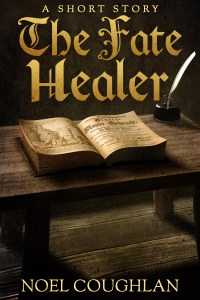
Just a quick note to let everyone know that my short story, The Fate Healer, is free this week until Friday 9th May.

A five thousand word short story where the quill proves to be more dangerous than any sword.

The genealogist Draston is charged with the impossible. His master, Hamvok the Merciful, craves a royal ancestor or two to legitimize his tyranny. But every avenue of Draston’s research comes to a dead end. Nobility has never sneezed on Hamvok’s ancestors, much less married into them. And now Draston’s time has run out.
To save himself from Hamvok’s violent displeasure, Draston promises to prove the tyrant is descended from a god. In doing so, he commits himself to a path of forgery and sacrilege. His enterprise will risk the wrath of gods. But, far worse, it will draw him to a shadowy figure more terrible than all the gods combined, the Fate Healer.


Available from Amazon.

The Gods of Mars By Edgar Rice Burroughs


841973

I found the  start of this book is actually more disorienting than its predecessor but it passes once a familiar face turns up. The book gives you the impression that the author wasn’t into organized religion, though that’s maybe reading too much into it. We discover that Mars is in fact layered like an onion with hidden races of cannibals and false religions. We encounter the white Therns and the black  First Born and their relationship to each other and the rest of Barsoom.

John Carter spends the novel either trying to escape one or other faction, or trying to rescue his princess from them. Dejah Thoris appears but hardly even speaks a word. Though John Carter only has eyes for her, nearly every woman he comes across falls for our hero. The exception is the villain Issus who is actually the strongest female character.

John Carter has a viking’s love of fighting and fortunately there is plenty of that. There are aerial battles aplenty. Whole armies are slaughtered.

If A Princess of Mars has a somewhat ambiguous ending, The Gods of Mars ends on quite a cliffhanger.